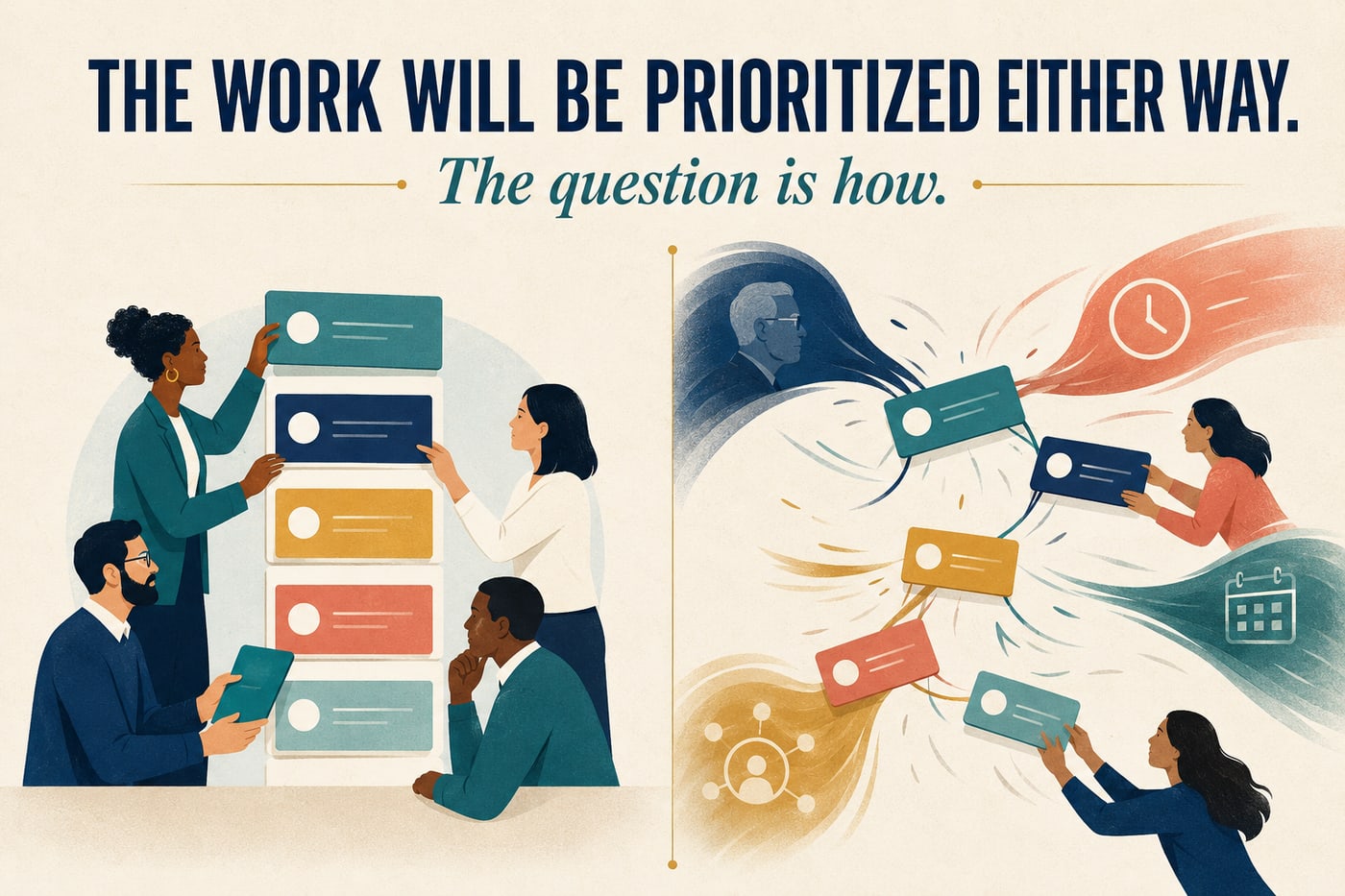
Ask a team what they should work on next. The answer tells you more about the organization above them than about the team itself.
Sometimes you get a clear answer. Often you get a question back:
Who’s asking?
That’s the sound of work being prioritized through negotiation instead of decision.
There is a list of projects. Everyone agrees they all matter. But nobody has ranked them against what the organization can actually deliver.
A list of projects is not a prioritization. It’s an inventory.
Prioritization happens when you hold that inventory against finite capacity and decide what comes first, what comes second, and what is not happening yet.
When leadership doesn’t prioritize, somebody else will
Here’s the part that gets missed most often.
When leadership doesn’t rank the work, the work still gets ranked. It just gets ranked informally — by whoever pushes hardest, who is most senior, who asked most recently, or who caught the right person at the right moment.
So the choice was never between prioritizing and not prioritizing.
The choice was between doing it deliberately and collaboratively, in a room, with the tradeoffs visible — or letting it happen by accident, one conversation at a time, with nobody accountable for the result.
The second option still produces a priority order. It just produces one nobody chose, nobody can explain, and nobody can defend when it turns out to be wrong.
Where the cost actually lands
Usually, it doesn’t land on the leadership team. That’s what makes the problem easy to miss from above.
It lands on the people doing the work.
A team with three unranked projects and capacity for one doesn’t get to escape the conflict. They get to live in it.
They negotiate with each sponsor separately. They start something, get pulled away from it, and start something else.
Picture what that actually costs.
A team spends three weeks getting deep into a system — learning its quirks, mapping how its data really moves, and building the mental model that makes the work faster. Then the priority shifts, and the team moves to something else.
Two months later, they return and have to rebuild much of that context before they can begin moving at the same speed again.
Nobody records that as an expense. It rarely appears on a status report. But across an unranked portfolio, rebuilding lost context can become one of the organization’s largest hidden costs and the only people who see it clearly are the ones absorbing it.

Delivery teams feel this first, and architects feel it acutely. Unresolved decisions flow downhill until they reach someone who has to design or build something concrete.
The result is a solution aimed at a target that changes depending on which leader spoke last.
Then comes the part that stings: when delivery slows down, the explanation lands on the team, not on the absent decision that made speed impossible.
Unresolved disagreement doesn’t disappear. It gets delegated to people with no authority to settle it.
Why good leaders end up here
I want to be fair about this, because it is rarely negligence and almost never indifference.
Every project on the list has a real sponsor with a real need. Telling a peer “not this quarter” isn’t experienced as a simple scheduling decision. It can feel like telling them their work doesn’t matter.
Multiply that by four peers, each accountable for their own initiatives, and prioritization becomes politically and personally expensive. It is easy in the abstract and costly in person.
Often, there is no forum for the conversation. Leaders meet to report status, not to trade capacity. Nobody has put the entire portfolio into one view alongside what the organization can realistically staff.
Prioritization also requires saying out loud that capacity is finite. In a culture where the expected answer is we’ll find a way, acknowledging that limit can feel like admitting failure.
None of that makes the outcome acceptable, but it helps explain why smart, well-intentioned people continue to land here — and why “just prioritize” isn’t useful advice on its own.
The meeting nobody owned
I sat down with a senior leader once to walk through progress, and he asked why one project hadn’t moved.
I told him the resources had been pulled onto something more urgent.
He said: that project isn’t on my priorities.
That was the entire problem in one sentence. He wasn’t uninformed and he wasn’t being difficult. He had a priority list. So did other leaders. Nobody had ever put those lists side by side.
When I said as much — that what we lacked was a forum where leaders reconciled their lists into one everybody signed up to — he agreed immediately. Then he asked the obvious question.
So why aren’t we doing that?
I said I’d raised it more than once with the person who owned the PMO, and it hadn’t gone anywhere.
Why don’t you do it?
I said that wasn’t my job. I wasn’t the head of the PMO.
I’ve thought about that answer a lot since.
The instinct wasn’t unreasonable. It was a fairly hierarchical environment, and stepping around whoever owned a function was the sort of thing that cost you later. That was a real consideration, not an excuse.
But I had a senior leader in front of me, agreeing with the diagnosis and asking who would pick it up. That is the rarest ingredient in this entire problem. Willingness at the top is usually what’s missing — and here it wasn’t missing at all.
What I’d say now is closer to: I can’t own this, but I can build the first version. Could you and the PMO lead get in a room, and I’ll bring the full portfolio alongside what it actually costs us to staff it?
That isn’t going around anyone. It’s offering to do the part nobody had done — assembling the picture — while leaving the decision exactly where it belongs.
I’m still not certain I’d have been right to push harder in that culture. If you’ve been in that spot, I’d genuinely like to hear how you played it.
The lesson I took is this: the gap often isn’t willingness. It’s that convening the conversation is nobody’s explicit job, so it stays undone while everyone assumes someone else owns it.
What good actually looks like
It’s less bureaucratic than people expect.
One ranked view, not a folder of documents. If leaders cannot see the portfolio together and in order, it has not been meaningfully prioritized. A PMO holding thirty project charters has inventoried the work, not sequenced it.
Ranked against real capacity. Not against ambition. If you have four teams, the list must be ranked with the knowledge that you have four teams.
The most important line on the page may be the one beneath the last initiative the organization can realistically staff. Everything below that line should be openly labeled not now.

Owned by the leadership team, not the PMO. This is the one I’d underline. A PMO can facilitate the conversation, maintain the list, provide analysis, and keep the process honest. It cannot make the decision on leadership’s behalf.
When prioritization is delegated to the PMO, leaders retain the ability to disagree with the outcome later. If everyone can reject the ranking, nothing was actually decided.
Published where teams can see it. If the people doing the work cannot name the top three priorities, the ranking exists only in a meeting — which is functionally the same as not existing.
Revisited on a cadence. Priorities change, and that’s fine. Reordering the portfolio deliberately every quarter is healthy. Reordering it continuously in response to whoever is loudest is the problem.
“Not now” treated as a real answer. This is the cultural piece that makes everything else possible.
Somebody’s project has to be fourth. If being fourth is treated as a loss, leaders will continue avoiding the conversation, and the organization will return to prioritizing through hallway conversations.
If you’re the one caught in the middle
Some practical advice, because most people reading this aren’t the ones who can fix the entire system.
Don’t silently resolve it yourself. You can analyze the tradeoffs and recommend an order, but don’t let a leadership decision quietly become your personal decision.
You cannot arbitrate a disagreement you don’t have the authority to settle. If you try, you become the person who chose — which means you also become the person blamed for whatever came second.
Surface the conflict with numbers, not frustration. “We have three requests and capacity for one” is a fact a leader can act on. “We’re overloaded” is a feeling they can only sympathize with.
Make the tradeoff explicit and ask for the decision.
We can deliver A this quarter or B, not both. Which do you want first?
That question does more than a vague escalation because it hands the decision back to the person who owns it, in a form they can answer.
If you can, include a recommendation and its rationale. The goal is not to throw an unresolved problem upward. It is to make the tradeoff visible, offer your best judgment, and get an accountable decision.
Then respect the answer, including when it isn’t the one you would have chosen. The goal was a decision, not your preferred decision.
The part worth remembering
Prioritization has a reputation as overhead — process for its own sake, something that slows delivery down. It’s the opposite.
It may be the single highest-leverage thing a leadership team can do for the people below it.
An unranked portfolio doesn’t give teams more freedom. It gives them the same finite capacity, plus the burden of deciding, defending, and being blamed for a decision that was never theirs to make.
Ranking the work is how leadership absorbs that burden instead of distributing it.
Saying “this one first” is not a restriction. For everyone downstream, it is what finally lets the work move.